

why Yesteryear failed
on publishing revenge porn, feministly

Caro Claire Burke’s Yesteryear hit all the benchmarks that a New York Times bestseller should: a propulsive premise (with a culture war lightning rod as centerpiece), a twist that lends itself easily to the silver screen, an author who doubles as an influencer—all-in-all, the undeniable promise of salience and success. Anne Hathaway bought the rights. Everyone is talking about it.
The book was enjoyable in the way high fructose corn syrup is enjoyable. It has all the right mechanics to hook you.
I couldn’t put it down, but I didn’t exactly enjoy it.
You know the story by now: tradwife influencer Natalie Heller Mills (the name’s emphasis on H’s, M’s, and N’s feeling very much like scrambled “Hannah Neeleman”) wakes up in the 1850s and is suddenly forced to live the reality of the life she’s been LARPing online. Spoiler alert: she’s an irredeemably cruel and abusive gremlin whose media empire crumbles upon exposure of her cruelty and abuse. After the media turns on her, Natalie self-imposes exile, and her cruelty and abuse does not relent, even as her grasp on reality does. The timeline shift is (twist!) actually a psychotic break.
The story is told in the first person, which was useful for the purpose of the plot, but Burke’s prose somehow retained the familiar cadence of a TikTok comments section. This was jarring given that Natalie was purported to have been raised in some flavor of fundamentalist evangelicalism, though we never discover which. Jerusalem Demsas said it well:
The word “God” is invoked more times as a curse (“God no,” Natalie laughs when asked about getting plastic surgery) or descriptor (“God-awful quilt”) than as the central figure of any Christian’s life.
Natalie’s venomous inner monologue is just-so: as clickity-clackity as any of the girls she meets when she is swept away to Harvard from small-town flyover country. Natalie’s observations don’t feel like those of an outsider, even as she describes the rarity of her own long hair and prairie dresses. We are told more than we are shown, and we are being told to hate this bitch.
Demsas goes on to note that Burke’s “secular childhood” is what rendered her incapable of entering, or at least unwilling to enter into the headspace of a religiously traditional woman, even despite her promises to do so:
Burke never reveals what denomination her main character belongs to — in fact, for most of the book, there’s little evidence Natalie even attends church as an adult. In an interview with The Rumpus, Burke revealed that “whether it’s Mormonism or evangelicalism or Jehovah’s Witness, it’s really all the same in terms of how women are treated and what the expectations are for them.” This shockingly naive statement came right after Burke told the interviewer that her “main focus” was to “understand the perspective and interiority of women who live in fundamentalist Christian communities.
What it seems like Burke is trying to say is that those Christian women are as dirty on the inside as the worst of the rest of us, and that religion itself is a performance, much like Natalie’s performance online. This is red meat for her own base of liberal feminists. Pharisaical preening is an easily recognizable pattern, especially in ideological spaces, where very religious and political people tend to congregate online. People love to notice this hypocrisy. And, you know, that’s fair game. The truth is that we are all sinners, and there is something particularly odious about wrapping one’s resentments in the cloak of piety. But it feels like a failure of imagination to impose (project?) patterns of speech and thought that might as well be foreign in order to make that point.
It could very well be that Burke’s secular upbringing gave her a blindspot, and it could very well be that the demands of her own audience gave her an easy way out, but another explanation underlies both of these possibilities. Burke, despite cutting her teeth on the sort of feminism that emphasizes the primacy of empathy, cannot find empathy for her narrator where it matters most.
Burke even gives Natalie’s husband, Caleb—who rapes and beats his wife in the “before times” setting, mind you—more legible vulnerabilities, more complicated human motivations, than she gives Natalie.
An author (or an actor) does not have to like their character, but if they’re going to access the sort of transcendence that makes art art, they have to be willing to get their hands dirty with the particulars. Empathy is the softening agent that allows the artist the freedom to enter that space, to discover the truth in it, to discover the humanity in it. The book sings in its threads on surveillance and internet-induced narcissism and psychosis, as Serena Sigillito observed in Fairer Disputations. The author herself is a very popular, very online Tiktok creator and podcaster; perhaps her own experience with overexposure gave her permission to dive deeper into that aspect of Natalie’s psychology.
No such exploration happens in the abundant, tensile waters of theology.
Like it or not, even mean, internet-poisoned, cynical and performative religious women are still people, and they have motivations and desires worth exploring: for certainty, for belonging, for transcendence. I don’t have a problem with Natalie being unlikable. I have a problem with satire being used as a cover not to make any insightful political commentary but to make a real person into a punching bag (observe Leigh Stein’s review and surrounding commentary as to why this does not actually qualify as satire).
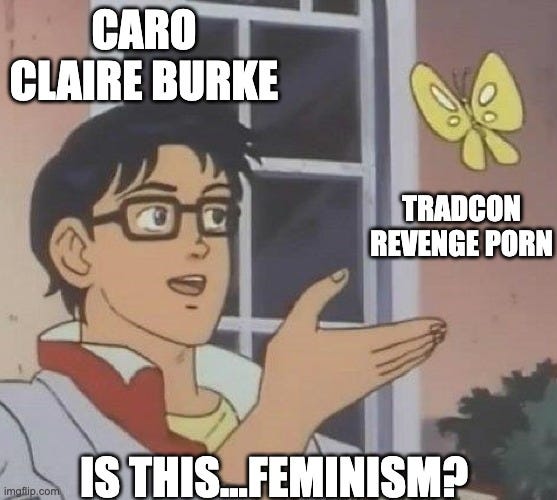
It felt spiteful. It felt like propaganda. It felt like beating a dead horse. The goal of this book, despite Burke’s stated aim, was not to understand. It was to humiliate. It is, in essence, revenge porn.
Burke should have chosen empathy; instead, she chose to burn an effigy. As the smoke clears, one cannot help but feel a little tired of the Something Being Said.
There are so many unsettling aspects to this book, but probably the most terrible - as you noted - is the fact that the abusive husband is contorted into a sympathetic character. IIRC Burke gave an interview saying that if the husband had married another person, he probably would have just been a nice, normal guy!!! So it’s NATALIE’S fault she was abused, right? If a man wrote this book, everyone would be rightfully horrified.
I think sometimes secular writers/audiences have a hard time understanding people can actually believe in what they profess, and that’s part of what CCB ran up against here.